Accelerating our transition to a sustainably growing company under a new management structure led by a CEO and a COO
Koichi Takashima
Representative Director, Chairperson and CEO
Following the General Meeting of Shareholders and Board of Directors meeting in June 2026, the Company transitioned to a new management structure led by President Yamamoto and me. As preparations for our goal of changing direction from sound management to a sustainably growing company are in place, we have put our transition to a sustainably growing company firmly on track under a management structure led by a CEO and a COO, with the two sharing responsibilities, with the aim of further accelerating the transition.
The shift from sound management to a sustainably growing company is a major turning point in the history of the Company, which just celebrated its 110th anniversary in 2025, and there are several key factors for our growth up to this point. We have achieved progress × fit by always keeping pace with the changing times and continuously renewing ourselves while remaining true to our corporate mission of “Contributing to Society through Our Business Activities” and our DNA of “Integrity,” and at the same time, our business has grown by evolving with the times.
However, when I was appointed President in 2004, the Company was in a challenging situation with no clear path to sustainable growth. Ensuring the Company can grow over the next 50 or 100 years became our top priority, so we promoted the concepts of sustainability and sustainable growth, which were still not ubiquitous at the time, within the Company and set the goal of becoming an advanced trading company. This is because we wanted to clarify the value of our existence—“Contributing to society through our business activities by drawing on original ideas and approaching society through Takashima Group’s unique means”—which underpinned our corporate mission.
To that end, for example, we presented three frameworks: the “Solution Framework,” “Risk Control Framework,” and “Development Framework.” The “Solution Framework” entails the creation of functions and solutions unique to the Company. The “Risk Control Framework” seeks to eliminate reliance on individual operational expertise and ensure continuity of the organization. By establishing mechanisms for joint management and operation within each department, we made progress in standardizing and streamlining operations. The “Development Framework” involves instilling the mindset that developing one’s successor, from frontline units all the way up to the top management of each business unit, is a task of paramount importance.
While we have sought to become an advanced trading company in the area of sustainability through these various initiatives, the turning point that accelerated our growth was taking on the challenge to meet the continued-listing criteria for the Tokyo Stock Exchange’s Prime Market. We set this as our top management priority and advocated a shift from sound management to sustainable growth in our previous medium-term management plan, “Sustainability V (Value),” and proactively implemented strategic initiatives to that end.
Among these initiatives, we placed particular emphasis on business investment, including M&A, and investment in human assets. In terms of business investment, we have executed M&A deals that allow our business to take giant strides forward through expeditious decision-making while focusing on the growth of existing businesses. We also recognize that recruiting and developing human assets that support growth as well as developing employees into valuable human assets are the key management challenges for achieving sustainable growth, and we are thus making aggressive strategic investments in our human assets.
As a result of these initiatives, the number of employees across the entire Group, including those from companies that have joined the Group through M&A, has increased rapidly. It is important that we harness the “centripetal force” to instill the DNA cultivated by the Company among our new Group companies and human assets. Furthermore, we must also harness the “centrifugal force” to expand our growth. The new management structure that we have introduced will propel the Company forward by making use of both these centripetal and centrifugal forces.
As a member of the founding family, I understand better than anyone else the DNA that is integral to the Company based on my 22 years of management experience. When it comes to harnessing the centripetal force such as our corporate philosophy and corporate mission, my role is to take the lead and proactively work to instill the Company’s philosophy. I also take seriously my role as the “face” of the Company to the outside world, and I intend to take the lead in IR and other activities as well.
As for harnessing the centrifugal force, I am looking forward to the work of our new President, Yamamoto. How can we harness the centrifugal force across the entire Group? We need to swiftly implement measures such as developing new businesses and acquiring new customers. Future changes start with the frontline. It is imperative to bridge frontline issues and possibilities with the centrifugal force, and by having someone who was closer to the frontline than I am serve as COO, I hope to see rapid progress in business restructuring, organizational reforms, and human assets development.
There is also another way in which the new management structure is significant. If we aim to be a company that continues for 50, 100 years, and beyond, we need a system that can sustainably produce successors. The Nominating Committee has spent nearly ten years thoroughly discussing a successor program, and with that system gradually taking shape under this new management structure, I see it as a major achievement that we could show we have taken a step forward. Given that I served as President, I hope that employees who wondered if someone outside the founding family could really become President will now realize that it is indeed possible, and that even more employees will aspire to take on management roles.
Since I was appointed President in 2004, the Takashima Group has placed sustainability at the core of its management and business growth, developing businesses that meet social needs and continuing to demonstrate the value of its existence through these efforts. While there are certainly environmental aspects to sustainability, I think of it as a philosophy that is central to the continued existence of both companies and individuals. When I reflected on what sustainable growth means for a sustainable company and for individuals 22 years ago, I was struck by the idea of becoming an advanced sustainability- focused trading company. If we develop businesses in sustainable domains, those businesses themselves will become sustainable. Demonstrating the value of our existence through such efforts will be consistent with our corporate mission. We are unwavering in embracing this philosophy going forward, and the Group will continue to forge ahead on the path to becoming a sustainably growing company as an advanced sustainability- focused trading company.
Through a wide range of strategic initiatives aimed at changing direction from sound management to a sustainably growing company, the Company’s earning power is growing steadily.
EBITDA has grown for five consecutive years, while gross profit and gross profit margin continue to improve. In terms of our human assets strategy, the concept of “career-type human assets,” where each employee plans his/her own career by being his/her own manager and continues to provide high value to society, is starting to take root. As this concept takes root across the entire Group and the number of employees putting it into practice increases, we can look forward to producing leaders that drive our business forward and successors for managers in a sustainable manner.
As these seeds of growth begin to sprout, we have formulated the Medium-Term Management Plan 2028 “Sustainable + Spiral (Sustainable Positive Spiral),” designating the next three years as a period for putting growth on track. We will continue to advance our ongoing strategic initiatives to contribute to profits and create a “sustainable positive cycle (Sustainable + Spiral),” where returns on investment fund further investment. We have established three basic policies for creating a sustainable positive cycle: (i) promote management conscious of cost of capital and corporate value; (ii) create a positive cycle of investment; and (iii) sustainable production of valuable human assets. By focusing on the three strategic themes of “labor-saving,” “resource- saving,” and “renewable-energy,” we will expeditiously invest resources to achieve a sustainable positive cycle.
Our founder Kotakichi Takashima had a strong conviction that becoming a listed company should form the foundation of our credibility, and the Company has been listed since the Tokyo Stock Exchange was established in 1949. This is a key feature of the Company’s corporate value, and we have always considered it the Group’s mission to engage with our stakeholders, meet their expectations, and contribute to the sustainable growth of society through our business activities.
As an advanced sustainability-focused trading company that contributes to a sustainable society, the Group will take a leap forward to become a sustainably growing company. Going forward, we would like to ask for the continued support and understanding of our stakeholders, including our shareholders.
Putting growth on track through a sustainable positive cycle while launching our new medium-term management plan “Sustainable +Spiral (Sustainable Positive Spiral)”:
Transforming investment into a positive cycle to set the Company on a steady trajectory of growth
Akira Yamamoto
Representative Director, President and COO
I am Akira Yamamoto, and I was appointed President following the General Meeting of Shareholders and Board of Directors meeting held on June 23, 2026. I was previously extensively involved in the Company’s construction supply business as Division Chief of the Construction Supply Division. With stricter enforcement of the Construction Business Act in the construction supply business sparked by the pile fraud scandal in 2015, many construction supply distributors withdrew from construction work, and the Company made a full-scale change in direction toward the contracting of construction work. I believe the crux of our strategy is to strive to create high added value for customers by providing functions that our business partners deem necessary but find challenging to implement on their own. We strengthened the Construction Supply Division by placing substantive construction functions at the core of the Division and regarding related processing and logistics operations as functions provided by the Company. I believe this strengthening of functions has led to M&A deals in recent years and is helping to establish a revenue base for the Construction Supply Division.
I have now been appointed President after serving as Division Chief of the Construction Supply Division, and I believe that my role in the top management position of the entire Group comes down to maximizing synergies through Group management, optimizing management resources, and driving the sustainable growth of our businesses. This means building reproducible earning power, which I believe entails fully transforming the Company into a value-adding trading company. A value-adding trading company refers to Takashima’s unique business model in which we are not merely a player in the intermediate distribution market but where we also provide functions and solutions needed by customers in target markets, which allows us to provide high added value and ultimately secure high profitability.
Ever since my time as head of the Construction Supply Division, I have worked as a Director together with Chairperson Takashima to advance initiatives, including sustainable management, strengthening of functions, and production of valuable human assets. As the new President, I will carry on the management approach that we have adopted to date, create a sustainable positive cycle, and lead the Takashima Group to the stage where it takes a great leap forward as a value-adding trading company.
With regard to our performance for FY2025, both sales and profit declined due to the impact of factors such as the recognition of losses related to DG Takashima Co., Ltd. EBITDA has grown for five consecutive years, reaching ¥4.0 billion, or a 7.2% increase year on year, demonstrating continued improvement in the earning power of our primary businesses. As for our performance by segment, while the construction supply and electronic devices segments posted disappointing results with a decline in both sales and profit, the industrial materials segment saw an increase in profit due to improvements in profit margins and other factors. FY2025 also marked the final year of our previous medium-term management plan, “Sustainability V (Value)” (hereinafter the “previous medium-term management plan”), which covered a period we positioned as one for sowing the seeds for the Company’s transition to sustainable growth. Even though we had set targets for net sales of ¥110.0 billion, operating profit of ¥2.6 billion, profit of ¥1.9 billion, ROE of 8% or more, and ROIC of 6% or more, we ultimately fell short of these targets. We recognize that the main reasons for this were sluggish growth in the profit of our primary businesses and returns that failed to keep pace with our investments.
Under the previous medium-term management plan, we rapidly advanced initiatives such as executing M&A deals nearly every year to strengthen our functions, making the Industrial Materials Division independent with Takashima Industries Co., Ltd. as its headquarters, and realigning the Construction Supply Division. As a result, we were unable to keep up with the development of internal systems and the establishment of investment monitoring mechanisms, which led to our vulnerabilities being exposed. However, we cannot achieve growth if we hesitate in the face of such challenges. We intend to continue taking on these challenges while overcoming the issues stemming from rapid execution.
Although the four companies that joined the Group through M&A each have their own unique attributes and have achieved some level of results, goodwill amortization expenses are putting pressure on our profit from an accounting perspective, and it cannot yet be said that they have delivered significant results in terms of their contribution to the Group’s consolidated profits. The issue at hand is how Takashima’s core business divisions will integrate and develop the respective functions of the four companies acquired through M&A over the past three years with those of HI-LAND Co., Ltd., TAKCEL Co., Ltd., and Rest Corporation, which had joined the Group earlier. Nevertheless, since there are capacity limits to the functions provided by each company, I believe it is essential to extend these functions while carefully evaluating those limits.
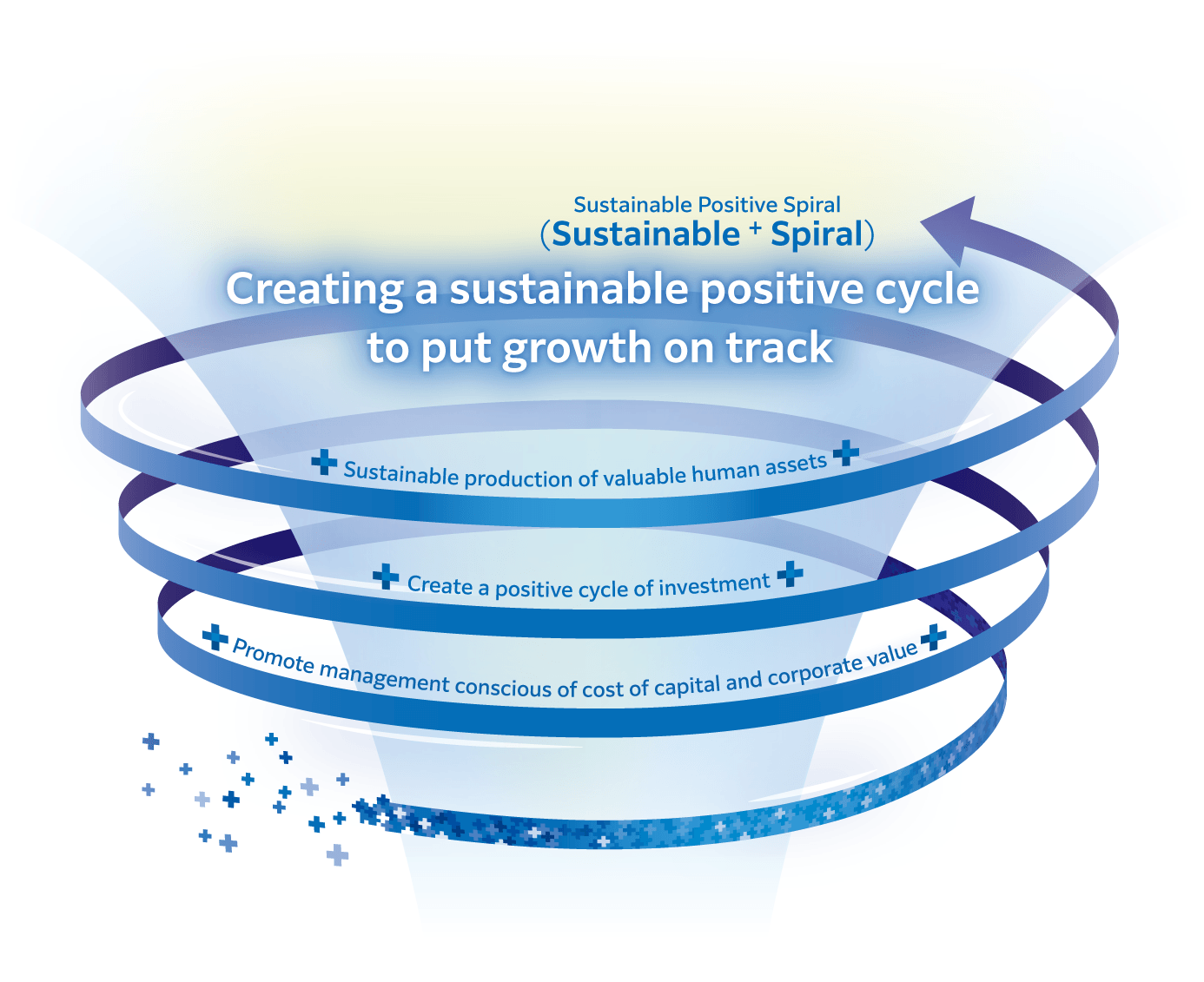
We formulated the new three-year Medium-Term Management Plan 2028 “Sustainable + Spiral (Sustainable Positive Spiral)” (hereinafter the “new medium-term management plan”), which begins in FY2026, to put our growth on track and take a great leap forward as a value-adding trading company by continuing to advance our ongoing strategic initiatives to contribute to profits and by creating a “sustainable positive cycle (Sustainable + Spiral),” where returns on investment fund further investment. The centripetal force instills the Company’s DNA throughout all Group companies, the number of which has grown. The centrifugal force nurtures the seeds that have begun to sprout from our business investment. By combining the centripetal and centrifugal forces of the positive spiral, we will further reinforce our ability to “Contribute to Society through Our Business Activities” and will contribute to building a sustainable society as the “Solution Partner” for each of our customers.
Furthermore, we are working to fundamentally transform the quality of the Company’s business, which constitutes the premise of our medium-term management plans to date, including the previous plan, as we believe that a traditional business model based on the pursuit of quantity is no longer viable. We have become convinced once again that the business model of a value-adding trading company, which generates profit without relying on quantity, is one that will give rise to businesses that contribute to building a sustainable society, which we have consistently pursued, and we are moving forward with this transformation in the quality of our business. This transformation in the quality of our business is a theme that the Company has always pursued, and it has become one of the key elements that constitute the basis of our strategies, starting with medium-term management plans.
In the new medium-term management plan, we have established three basic policies for creating a sustainable positive cycle: (i) promote management conscious of cost of capital and corporate value; (ii) create a positive cycle of investment; and (iii) sustainable production of valuable human assets. The key to promoting management conscious of cost of capital and corporate value in the Company is shifting the focus of business promotion from products to the market. We will transform our business portfolio in a flexible manner by addressing the social issues confronting markets. We believe that shifting from our traditional business approach of structuring our portfolio and developing strategies around products to one that is focused on the market while keeping end users in mind will ultimately increase cost of capital and corporate value.
Creating a positive cycle of investment is a matter of strengthening functions and a battle against capacity constraints. For a business that sells finished products by focusing on volume, there is little difference between the effort required to sell 10 units and that required to sell 100 units. However, functions that integrate processes such as planning, design, processing, construction, and distribution in creating products and services grapple with the issue of capacity. To achieve a positive cycle of investment, it is essential to increase this capacity. Through the expansion of group synergies and the continuation of strategic investments on the scale of ¥10.0 billion, including M&A, we will increase the capacity of our functions, extend their target domains, and expand their service areas.
The sustainable production of valuable human assets is of paramount importance to a trading company. For a trading company, people are both its greatest asset and its greatest cost. The structure of a trading company is such that improving the productivity of each individual has a direct impact on business performance. The crux is not merely the development of “super salespeople,” but the sustainable production of human assets that can generate profit. Under a strategy and an organization capable of generating profit, we will establish a system that sustainably produces human assets capable of generating profit in line with our winning formulas. On that basis, each individual must fully assimilate and internalize the strategic themes necessary for our success. We believe that ensuring employees can work to deliver results will lead to the sustainable production of valuable human assets.
In the new medium-term management plan, we defined three strategic themes that would allow such valuable human assets to succeed in business. We have evolved the strategic themes of labor-saving and energy-saving defined in our previous medium- term management plan into the three strategic themes of labor- saving, resource-saving, and renewable-energy. By combining these themes with enhanced on-site capabilities through the improvement of functions, we will further accelerate our response to social issues and the creation of a sustainable society. We will focus on and aim to commercialize fire-resistant/seismic-resistant high-performance building materials, labor-saving construction methods, custom logistics materials, and electronic board mounting/assembly under “labor-saving”; insulation materials, recycled materials, and energy-saving devices under “resource- saving”; and solar panels, storage battery systems, and EV- related products under “renewable-energy.”
I am sometimes asked what I think are Takashima’s unique position and strengths. Since our three Divisions operate in different industries, it is difficult to describe our strengths in aggregate. However, I believe that we possess the flexibility of a value-adding trading company in each Division, and our speed in decision-making and execution can be considered one of Takashima’s strengths. While the Company is backed by strengths such as its network and credibility established over its long history, this history can sometimes hinder flexibility. In that regard, although we boast a long history, we are confident in our ability to move quickly, and we often hear people asking how we can make decisions so quickly for such a long-established trading company. This is attributable to the speed of response from the business frontlines to management decision-making, and our flexibility is also the very quality that has allowed us to execute M&A deals nearly every year over the past few years. As exemplified by our swift M&A deals, we view the speed with which we channel energy into our growth engines as our greatest strength in responding quickly to change. On the other hand, we recognize that this flexibility also involves “thinking on the move” and naturally entails risk. While we will not change our stance of prioritizing growth opportunities and possibilities, we will continue to enhance the accuracy of investment monitoring and hone our flexibility going forward.
As for improving corporate value, our financial challenges include improving operating margin, enhancing capital efficiency and ROE, and ensuring stable and flexible shareholder returns. On the non-financial front, our challenges include investing in human capital, such as establishing a system to produce valuable human assets and strengthening engagement, as well as enhancing our brand, and streamlining operations through AI and digital transformation. While we have seen some results from our past initiatives, we will redouble our efforts to improve corporate value.
Since corporate value is determined by stakeholders and the market, the functions we offer have no meaning unless their value is appreciated by end users and the market. Moreover, this value is not universal in nature but is constantly evolving. Instead of a “product-out” approach, we will adopt a “market-in” approach in order to align our perspective with that of the market and hone the sensitivity needed to understand the value the market seeks, from the frontline all the way up to management.
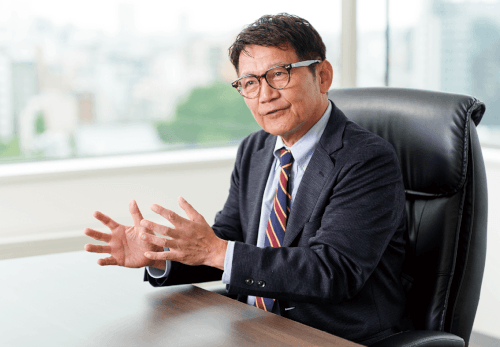
The period covered by our previous medium-term management plan, which advocated a shift from sound management to sustainable growth, was a phase for sowing and nurturing the seeds of growth. The period covered by the new medium-term management plan is a phase for creating a sustainable positive cycle in which we recover our past investments and channel the resulting capital into further reinvestment. As the new President, I have been handed the baton to steadily advance this recovery and reinvestment of capital. We can put sustainable growth on track by expanding the capacity of the businesses we have invested in and their functions, achieving sufficient returns to allow for reinvestment, and then reinvesting those returns.
The Company emerged from the challenging circumstances around 2004, when then-President Takashima took over management and we were recording losses for consecutive years, moved into a phase of stable profitability in the 2010s, and subsequently entered a phase in which we could invest for growth. We have currently entered a phase aimed at achieving sustainable growth through the recovery and reinvestment of capital, and we are confident that by steadily achieving the goals of the new medium-term management plan, we will be able to take a great leap forward as a value-adding trading company by 2030.
The Takashima Group will continue to refine its role as a value- adding trading company and contribute to the realization of a sustainable society through its business activities. Going forward, we would like to ask for the continued support and understanding of our stakeholders, including our shareholders.
関連リンク
